Ankle and leg orthotics in Montreal
Custom and prefabricated ankle and leg orthotics to treat sprains, foot drop, joint instability, and support post-surgical recovery.
Conditions we treat
The ankle and leg support the entire body weight and bear considerable forces during walking, running, and daily activities. Injuries and conditions affecting these structures can have a major impact on mobility and quality of life. At Marchildon, our orthotists have the expertise to assess and treat a wide range of lower-limb pathologies with tailored orthotics.
Ankle sprains
Ankle sprains — whether acute or recurrent — benefit from stabilization orthoses that protect the ligaments during healing and prevent re-injury. For chronically unstable ankles, custom orthoses provide permanent support while still allowing physical activity.
Foot drop
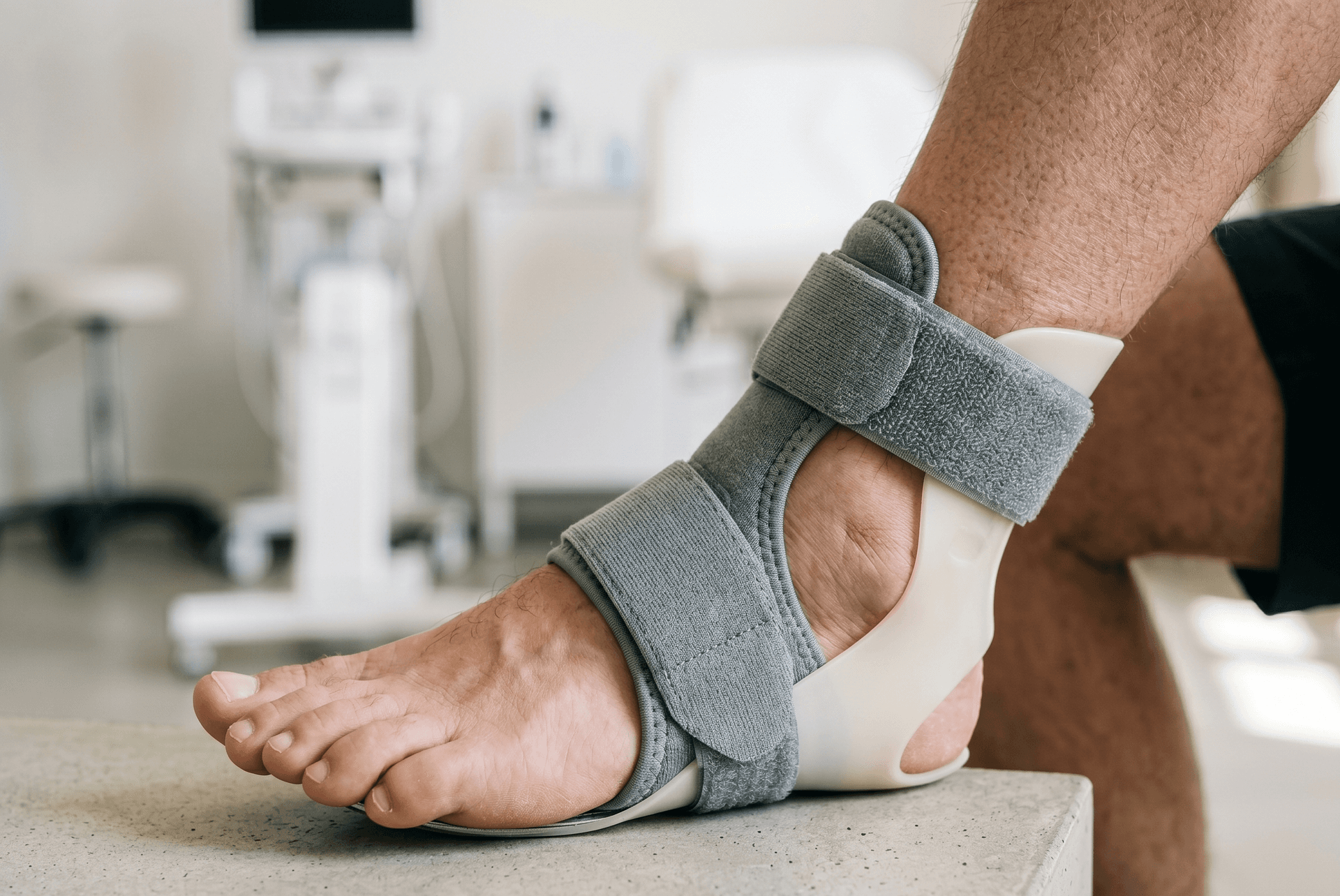
Foot drop is the inability to lift the foot during walking, caused by muscle weakness or nerve injury (stroke, multiple sclerosis, peroneal nerve injury). The ankle-foot orthosis (AFO) keeps the foot in a functional position, preventing falls and improving gait quality.
Post-surgical recovery
After ankle or leg surgery, specific orthoses protect the operated area and guide recovery. Controlled-motion boots, articulated orthoses, and post-operative splints are adjusted to your surgeon's protocol.
Splints and support
For conditions needing temporary or permanent support, we offer ankle splints, stabilization bandages, proprioceptive ankle braces, and night splints for the Achilles tendon and plantar fasciitis that doesn't respond to foot orthotics alone.
Types of orthotics available
We offer a complete range of lower-limb orthotics, including rigid and dynamic ankle-foot orthoses (AFO), stabilization ankle braces, controlled-motion walking boots, night splints, and knee-ankle-foot orthoses (KAFO) for more complex neurological conditions. Each orthosis is selected and fitted based on your diagnosis, mobility goals, and lifestyle.
Our assessment process
Assessment for a lower-limb orthosis at Marchildon includes a detailed physical exam of the ankle and leg — stability tests, range-of-motion and muscle-strength evaluation, and gait analysis. Your orthotist determines the most appropriate type of orthosis and proceeds with the necessary measurements or casting.
Regular follow-up is recommended to adjust the orthosis as your condition evolves and ensure it continues to meet your needs.
Our orthotists are members of the Ordre des technologues professionnels du Québec (OTPQ) and the Association des Orthésistes-Prothésistes du Québec (AOPQ).
Frequently asked questions about lower-limb orthotics
What lower-limb conditions do you treat with orthotics?
We treat a wide range of conditions including ankle sprains, foot drop, chronic ankle instability, healing fractures, sequelae of stroke or neurological diseases affecting gait, Achilles tendonitis, treatment-resistant plantar fasciitis, and post-surgical recovery of the ankle and leg.
What is an ankle-foot orthosis (AFO)?
An AFO is a device that wraps around the foot and ankle, sometimes extending up to the calf. It controls the movement of the ankle and foot during walking. AFOs are used to treat foot drop, stabilize the ankle, assist walking, and protect healing structures.
What's the difference between a rigid and a soft ankle orthosis?
A rigid orthosis provides maximum support and strict motion control — recommended for foot drop, severe instability, or post-surgical recovery. A soft or semi-rigid orthosis provides moderate support while allowing more mobility — ideal for mild sprains, return to sport, and preventive support.
How long does it take to adapt to an ankle orthosis?
The adaptation period varies by orthosis type. A soft orthosis can be comfortable from day one. A rigid orthosis (AFO) generally requires 1 to 2 weeks of gradual adaptation. Your orthotist will give you a graduated wearing protocol and will adjust the orthosis if needed to optimize comfort.
Are lower-limb orthotics reimbursed?
Yes — lower-limb orthotics prescribed by a physician are generally covered by RAMQ, CNESST, SAAQ, and private insurance. The reimbursement amount depends on the orthosis type and your coverage program. Our administrative team will guide you through all the procedures.
Can I wear my regular shoes with an ankle orthosis?
It depends on the orthosis type. Soft orthoses and some semi-rigid orthoses are compatible with many shoes. Rigid AFOs often require deeper shoes or orthopedic shoes to accommodate them comfortably. Your orthotist will advise on compatible footwear.
Do you offer orthotics for foot drop after a stroke?
Yes — foot drop caused by stroke or other neurological conditions is one of our specialties. We offer custom ankle-foot orthoses (AFO) that compensate for muscle weakness, prevent falls, and significantly improve gait quality. The orthosis is personalized to your level of function and mobility goals.
Browse our selection
Our lower limb orthotics are available in our shop, with professional fitting by our orthotists.
View productsLearn about reimbursements
Discover RAMQ, CNESST, SAAQ, and private insurance coverage options for your lower-limb orthotics.
See reimbursement optionsBook an assessment
Our orthotists will assess your ankle or leg and propose the orthosis best suited to your condition.
Book an appointment